Thursday, April 14, 2011

How to Manage Aggression


Aggression, is one of most interesting motive in field of psychology. Here attempt has been made to elaborate its practical side with respect to its management in day to day activities. I hope; it will be valued learning and enjoyable reading.

I have provided text of my article; some of my readers requested that due to slow internet and restriction over picture files in offices and universities, they fail to enjoy reading. I believe they all shall be delighted now.

------


How to Manage Aggression?

By: Prof. Ayesha Kashif

Aggression is considered to be one of the human motives. It comes under the category of psychological or social motives. Although psychological/social motives are not important for one’s existence or survival; but these motives play so much important part in our lives that sometimes our whole life is spent to achieve these motives. Sometimes these motives are so persistence in us, that they became the permanent characteristics of our personality.

What is Aggression/Anger?

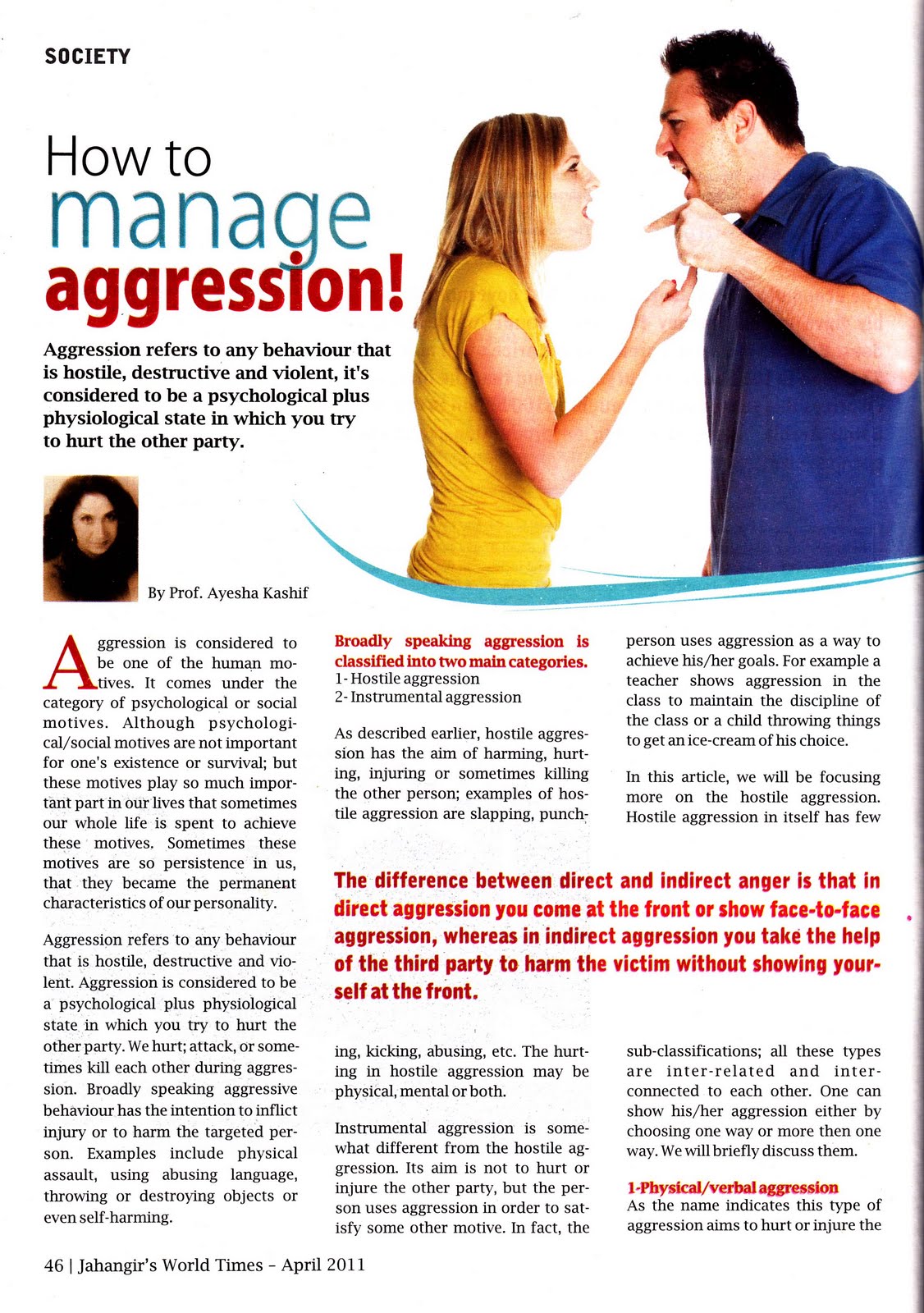
Aggression refers to any behavior that is hostile, destructive and violent. Aggression is considered to be a psychological plus physiological state in which you try to hurt the other party. We hurt; attack, or sometimes kill each other during aggression. Broadly speaking aggressive behavior has the intention to inflict injury or to harm the targeted person. Examples include physical assault, using abusing language, throwing or destroying objects or even self harming.

Categories of Aggression:

Broadly speaking aggression is classified into 2 main categories

1) Hostile Aggression

2) Instrumental Aggression

Hostile Aggression:

As described earlier, hostile aggression has the aim of harming, hurting, injuring or sometimes killing the other person; examples of hostile aggression are slapping, punching, kicking, abusing etc. The hurting in hostile aggression may be physical, mental or both.

Instrumental Aggression:

Instrumental aggression is somewhat different from the hostile aggression. Its aim is not to hurt or injure the other party, but the person uses aggression in order to satisfy some other motive. In fact the person uses aggression as a way to achieve his/her goals. For example a teacher shows aggression in the class to maintain the discipline of the class or a child throwing things to get an ice-cream of his choice.

In this article, we will be focusing more on the Hostile Aggression. Hostile aggression in itself has few sub-classifications; all these types are interrelated and interconnected to each other. One can show his/her aggression either by choosing one way or more then one way. We will briefly discuss them.

i) Physical/Verbal Aggression

ii) Active/Passive Aggression

iii) Direct/Indirect Aggression

Physical/Verbal Aggression:

As the name indicate this type of aggression aims to hurt or injure the victim either physically or by words, and sometimes both. The typical example of physical aggression is when we physically injure the other party. The physical torture might also be accompanied by different weapons like hunters, guns and pistols etc. Whereas in verbal aggression the purpose of the person is to harass or harm the victim by his/her words. This type of aggression is most common as in our day to day life we often see people using abusive language or shouting at others.

Active/Passive Aggression:

In this type of anger, people show their aggression either by their overt behavior of they show their aggression in a passive way by frustrating the other party by their behavior. In active aggression your aggression is obvious and visible to the victim. Example of active aggression could be stabbing, shooting or killing an enemy. Passive aggression has even more interesting characteristics in itself. People adapt this way of aggression when the other party is more influential or powerful or he/she does not have enough courage to show the aggression overtly. In passive aggression the aim of the person is to frustrate the other person and in that way they satisfy their aggression. One of the most common examples in husband and wife relationship is when one spouse deliberately stops talking to the other one or start ignoring his/her partner, or listening to loud music when the other one is sleeping, or a servant deliberately burning the clothes while ironing or putting intense salt or spices in the dish to satisfy his anger.

Direct/Indirect Aggression:

The difference between direct and indirect anger is that in direct aggression to come at the front or show face to face aggression, whereas in indirect aggression you take the help of the 3rd party to harm the victim without showing yourself at the front. The most common example of indirect aggression is when someone hires a profession killer to shoot the enemy.

A few of the common examples in which the person shows a blend of aggression categories are discussed here for further clarification.

· Kicking or slapping the victim (direct, active, physical)

· Abusing or shouting over the victim (direct, active, verbal)

· Cracking a dirty joke over the victim (direct, passive, physical)

· Spreading wrong propaganda against victim (direct, passive, verbal)

· Pushing someone standing in a queue (indirect, active, physical)

· Stop talking to the other person (indirect, passive, verbal)

· Rejecting or refusing to do an important assignment (indirect, passive, physical)


Few Tips to Manage Your Anger/Aggression:

· Give a vent to your anger. Anger gets aggravated if it is accumulated inside you for long period of time. So instead of shouting at the people in anger it’s always a good idea to shout loudly in an empty room. Shout, scream, cry or even breaking a plate can calm down your aggression.

· Try to relax yourself by taking deep breaths. It usually helps a lot.

· Involve yourself in some physical work like cleaning the bathroom or washing dishes or sometimes its good to throw your cloths out of your wardrobe and start arranging them again.

· Learn to act and not react. Reaction towards something usually embarrasses you when you come out of the sate of anger.

· Avoid the anger provoking situation. Try not to discuss those hot topics that vent your anger. Try to have less interaction with those people who stimulates your anger.


Tuesday, March 15, 2011

Relationship break-ups; An Increased cause of despair


My article regarding relationship break-ups and its key reasons accompanied with solutions has been published in recent month (March 2011), World Times magazine.
We should respect and take care of those people whom we love, "either by making a relation or breaking a relation."

It is about key concern of upcoming generation, that is "relationship break-ups". Primarily due to high expectations from other party and due reliance over mode of communication that lack non-verbal cues. Without realizing its repercussions.


In this busy world, where everyone is lacking time, flame of suspicions burn castle of trust in ashes. Plus; in eastern cultures as of ours, cultural restrains and mountainous high limitations also cause young couples to break-up before getting into bond of marriage


Last, but not least. At times, very loving members step away from life of loved ones, assuming that their presence may cause some negativity.

----------


Relationship Break-ups……An Increased Cause of Despair!

By: Prof. Ayesha Kashif

Break-up is a term that is very commonly used for the “Ending of a relationship” A break-up can be between siblings, parent-child, relatives, friends or between husband and wife. But since one cannot completely breakup relations socially and legally with his/her immediate blood relatives (especially in the eastern cultures) so normally focus stays over friends and the intimate relationships. It is usually said that “A broken relationship is better than a disturbed one” but often it is not very easy to break a disturbed relationship; as members are either emotionally financially or socially dependent over and other; that they prefer to drag a disturbed relationship then to go for a broken one.

Break-ups usually are very depressing and emotionally shacking. Longer the duration of relationship, more difficult and depressing would be the break-up, and more time will be required to overcome. But sometimes, time durations does not matter, as people develop strong bounding in few days, and studies show that they undergo the same level of anxiety and depression as any other couple having long duration relationship. Sometimes it takes years or even a life time to heal the wounds of a break-up.

Most Common Causes of Break-ups:

Lack of communication or miscommunications:

One of the biggest problems of today’s world is that majority has busy routine. Either it be a house wife or a busy professional, everyone is lacking in time. This leads to increased gap. Moreover texting messages or sending e-mails is very common these days, but one of the biggest drawbacks of such channel of communication is the absence of non-verbal cues (facial and voice expressions) so the chances of misinterpretations increases. So we should be very careful to choose the right kind of channel of communication while conveying our emotions and feelings to our companions.

High expectations from the partner:

Majority expects other partner to be more adaptable; and should change for us. At the same time we perceive our self is perfect and do not require any alterations. This in one way or the other makes the other partner feels down and ultimately hurts his/her ego. It is suggested that both the partners should be flexible to change a few of their habits to win the love of their partner.

Family or Parental Pressures:

Societal or family pressures are another very common cause of relationship breakups especially in eastern countries or places where families or parents take marriage and other important decisions on behalf of their children. Relationships are very vulnerable when families jump into the private and personal matters of a couple and apply restrictions. In such situations one should not spoil a smooth relation just because of such constrains.

Lack of Trust

Suspecting or doubting the intentions of your partner often leads to disasters. Suspicion arises when you start feeling insecure or stop trusting your love. One of the common causes of this could be a third party or some jealous person who intervenes in your relationship and provokes you to doubt your partner. So instead of trusting what other people say, listen to the voice of your heart and have trust and faith over your love.

Conflicting and Mismatched Personalities/Age gap

Most of the time in the beginning of a relationship due to physical appeal or some other attractions people accept each other’s different personalities open heartedly, but as time passes by and relationship grows older, their patience level deteriorates and disliking from both ends come up. So in case of having opposite interests, try to find the positive aspects in those opposite habits and traits of your companion instead of getting irritated.

The Other Side of Picture:

Being a psychologist I come across a lot of incidents almost daily that result in a breakup due to the above mentioned reasons. As majority of these causes are the ones that are conflicting and clashing and that can finish the element of love and result in breakup. But things are not always the same i.e. Relationship does not only end when you stop loving your partner, but it also happens when u start loving your partner more and more. This seems to be quite confusing and weird but it’s true. Here I would like to quote a few of the incidents to make my point clearer.

One of my clients deliberately ditched his partner and broke up the relationship as he was suffering from a STD (sexually transmitting disease) and he never wanted to see his partner dying in agony and misery of that disease. I still remember I could very well see the depth of his love in shedding tears.

In another incidence the female companion prefers and opted for a break-up as she knew that their continued relationship could cause problems in the upcoming life of her partner. The societal and religious barriers were another cause of mental torture for her companion. She had well perceived the fact that her existence in his life will not only affect his mental health but his future could also be at stake due to her presence in his life. So she quietly moved away from his life. I can memorize vividly how much mental agony and misery she faced after the breakup but she faced it boldly and accepted it happily because “she loved him”. And for her, his happiness and success in life was more important than any other thing.

In the end I will just re-emphasize that relationships are precious. No one in this world is luckier than the one who has got sincere people around him/her. It takes years to make a relation and few second to destroy it. So we should respect and take care of those people whom we love, “either by making a relation or by breaking a relation”.


Thursday, February 10, 2011

Overeating and Depression

Respected Readers,

It is of utmost delightment that my recent article got published in Chef Special; about over eating and depression. It has been my area of interest for quite a while, I observed numerous samples, while counseling and though my general observation. But after diving deep into literature; accompanied with empirical research; I realized that here exist significant link between over eating and depression. Have enjoyable reading.

3


-----------------


Stress & Depression Leads to Over Eating & Obesity:

By: Prof. Ayesha Kashif

Tasty and tempting food is enjoyed by almost all normal human beings; yet few get to control their appetite and others let themselves flow over circumstances. One general observation about majority of hospitals around the globe depicts increased trend of diseases related with overeating and obesity. Other than being fan of tasty foods, and taking it as form of enjoyment, there are other reasons people get to eat more than their required diet. One of the key reasons is “Stress & Depression”. YES! It has been an established fact by now that humans tend to take more food when they are stressed or depressed. By now it is quite hard to identify that either depression induces obesity or its other way around. It is often believed that it is “Two Way Street”, but dilemma of chicken/egg problem stays.

What is Stress Eating: Stress eating occurs when we try to resolve a problem or conflict by eating, as eating is considered to be a “pleasure” for almost all human beings, so in order to gain pleasure and divert our attention form the stressful situation we eat, even when we are not hungry.

In order to keep things simple; before we proceed, let us have a look at some of stress inducing factors that are likely to lead to depression. Some of most common factors are:

• Death of a loved one

• Marital problems

• Major personal injury or prolonged illness

• Academic failure

• Unable to cope with educational burden

• Pregnancy

• Increased work load

• Change in living conditions

• Sleeplessness

• Divorce/ Broken Relationship

• Serious arguments with girlfriend or boyfriend

• Change in eating habits

• Financial issues

• People’s undue expectations from you

• Unstable political or economic condition of the country

Due to whatever factor humans get depressed, they are likely to increase or decrease level of food intake. Majority goes for increased food intake; now question is why do they do so? There are several believes about it. Although; one thing is sure that Humans see “Satisfaction in Eating” in state of depression. As during depression we feel “Worthless” and lost “Self Esteem” it is likely that we start focusing to the basic needs. And food seems to elevate us by making us filled to upper level of needs. Although as source of depression stays in our mind. We get back to level one, and take support of food as it helped us in past.

Commonly heavy eaters elaborate it as act of attaining Euphoric feeling” (feeling of joy). Although it just serves as food for more food craving. Just like initial stage drug addiction cycle. Temporarily heavy food input satisfy physiological motive, and one feels satisfied for short interval of time; latter “feeling of guilt” due to failure of self control takes over, and promises are made to self that tomorrow or in future it will be different. With time that self esteem is further killed with failed self control and overeating becomes addiction in itself. As every next time desire is to take even more food to attain that “Euphoric feeling”, Over eating also results in over sleeping, eventually leading to obesity and poor motor skills, physical appearance, movement problems, lower resistance to temperatures and many other sources combined results in greater depression. And this spiral destroys human life, emotionally and physically.

Now question arise how to control it? Obviously by breaking this cycle, solution to this we will start with a quotation that will summarize overall philosophy and solution.

Know yourself & Know your enemy, you can win 100 battles without disaster”

Here is a difference between obesity and overweight; but for now we will try to use words interchangeably. For brief explanation Obesity = %age weight. And Overweight is dependent over BMI (Body Mass Index), we are providing this information here because we need to know our limits; and to avoid being overweight we at least need to know at what limit we will be considered over weight?

BMI Formula = KG/ (Meter*Meter), Pounds/ (Inch*Inch)

BMI

Weight Status

Below 18.5

Underweight

18.5 -24.9

Normal

25 - 29.9

Overweight

30 & Above

Obese

National Institute of Mental Health (USA) found that nearly one out of four cases of obesity is associated with a mood or anxiety disorder.

How to overcome this problem:

In order to get away from this problematic spiral, first step is to get weighing machine and determine your target. Choosing the right kind of food is the first step towards the solution of this problem. Try to choose such foods that are less oily and less sweet but more nutritious. Avoid all kinds of junk food and drinks. Exercise is greatest way to reduce weight, moment we start burning our fats, depression seems to burn too. Exercising requires strong self control to just start it; for initial few weeks it requires winning battle of self commitment daily; after that it follows. Take out your depression over treadmill or jogging track. We live in dynamic world; where nothing is consistent, so is the source of your depression; soon it will be covered in dust of time. Plus keep your expectation lowest from this world, so low that you stay prepared for worst. Return more love to world, while establishing courage to say “NO!” especially to your own self. Buy new cloths, as form of celebration whenever you attain weight reduction goal. Letting yourself flow with time, will only leave you over others. Nothing positive will happen at its own; Take control of your destiny or someone else will. Have a happy, healthy and stress free life: it’s precious.

Tuesday, October 26, 2010

Depression More Frequent in Women


This is to intimate my readers that another article of mine has been published in "Chef's Special (English)" Oct-2010. This article is about fact that women are more vulnerable to risk of depression than men.


Although article’s primarily focus is over females, identifying reasons of their depression backed with sound suggestions to overcome this negative feeling. But for men this will help them understand opposite gender (females) better, And to take good care of them.


Hope you will have enjoyable reading.


-----------------


Why Depression is More Common in Women than Men?

By: Prof. Ayesha Kashif

The history of depression is as old as the history of mankind. Moreover it is a well established fact that women are about two times more likely to suffer from depression as compared to men. This two-to-one ratio is common in almost all the different cultures, regions, religions and geographical areas. In fact, this gender difference in rates of depression is found in almost all the countries across the globe. A lot of factors have been identified and pinpointed to explain higher incidence of depression in women. Many factors have been implicated, including physiological, psychological, and social factors.

Depression is considered to be a serious condition of prolonged grief and sadness that can negatively affect you in every area of your life. This feeling can affect your personal, professional as well as social life.

If you feel prolonged sadness, feeling of guilty, tiredness, muscular tension and cramps, sleep disturbance or just generally feeling low, you may be suffering from major depression. But depression is curable and treatable, so no need to be depressed at your depression. The more you will know about it the more easily you can manage and overcome it.

The most common signs and symptoms of depression are as follows:

  • Feelings of sadness, grief or hopelessness
  • Feelings of anxiety and tension
  • Panic attacks
  • Inability to concentrate on work
  • Fatigue and low energy level
  • Episodes of crying
  • Loss of interest or pleasure in activities once you used to enjoy
  • Guilt feeling and worthlessness
  • Suicidal thoughts
  • Sleep disturbance (sleeping more or sleeping less)
  • Increase or decrease in appetite and weight changes
  • Mood swings and fearfulness
  • Persistent irritability or anger
  • Feeling out of control
  • Physical symptoms (bloating, breast tenderness, headaches, muscle pain)

Why women are at greater risk for Depression? Part of the answer lies in the fact that females have different biological make-up then men. Researchers have confirmed that hormones have an effect on the brain chemistry that controls one’s emotions and mood. A few of the physiological factors especially in women are discussed precisely.

Menstrual/Periods Problems – Changes in the level of hormones during the menstrual cycle can trigger some symptoms of depression such as muscular cramps, mood irritability, anger, fatigue, and emotional disturbances. For many women, these symptoms are mild. But for some women, symptoms are serious enough to disturb their normal day to day lives.

Pregnancy and Infertility - Pregnancy can cause a lot of hormonal fluctuations in women that can lead to depression, particularly in those women who are having genetic background or family history for depression. Such women are usually at high risk of depression during pregnancy. Moreover unwanted pregnancy, miscarriage and infertility can also contribute to cause depression in majority of the women.

Postpartum Depression Soon after the child birth majority of the women experience mild to moderate form of depression and anxiety commonly known as “Baby Blues” it contains crying episodes, fearfulness and panic attacks. However in few women it is quite severe that needs to be treated with anti-depressant medicines and rigorous counseling sessions.

Menopause: Menopause is considered being a period of time when a woman end having her regular monthly periods and encounter problems related to the lack of estrogen (female sex hormone) production. Studies shows that a lot of women experience not only physiological disturbances but also psychological and emotional disturbances during and after the period of menopause. Depression is one of the most common psychological problems confronted by majority of the women.

Common Ways of treating Depression in Women:

The good thing about depression is; that it is 100 percent curable if taken proper treatment on time. The commonly used methods are psychotherapy and the use of anti-depressant medicines; depending upon the nature and severity of depression. Sometimes having a counseling session with a psychologist is as effective as any rigorous drug therapy, as a supportive counselor can help you to identify the factors that can contribute to your depression and can also guide you to cope up with those depression inducing factors. In this way you can overcome your pessimistic thoughts and unrealistic fears. In some instance you might have to change your lifestyle if it is constantly causing stress that is ultimately resulting in depression.

Postpartum depression or depression after the child birth should be handled carefully. If a woman is breastfeeding the baby, the decision to take an antidepressant medicine must be taken in consultation with the doctor.

Depression linked with reproductive cycle:

Hormonal imbalance associated to the reproductive cycle can have a great influence on woman’s emotions and mood. In light of this possibility, it is important that you should consult your doctor so that he/she must investigate that weather your depression is linked with your reproductive cycle or it has some environmental cause. It is also important not to over look mood disturbances associated with the side effects of using birth control pills and hormonal imbalance therapy.

A few and little changes in your lifestyle can help you to overcome depression:

Daily Exercise: Simple but regular aerobic exercise, morning walk and yoga can help manage the symptoms of depression especially the one’s related with pre-menstrual symptoms of depression.

Minor Changes in Your Diet Plan: Try to eat more fruits and vegetables in your diet. Prefer Carbohydrates in your food then fats, moreover try to avoid excess salt and caffeine, oily and fatty food is also not recommended. Taking a good multivitamin tablet regularly will definitely benefit you.

Share your Feelings: Sharing your feelings with any of your sincere friend, or family member will definitely help you to overcome your depression, as in this way you will not only get good suggestions from them; but it is also a great way of making catharsis.